A trackless train is a simple machine on a flat surface and a difficult one on a badly prepared floor. Indoors, where routes cross polished tiles, expansion joints, and service corridors, floor conditions decide how smoothly the train runs and how often tyres and bearings are replaced. This guide covers the indoor trackless train floor conditions that should be checked before operation begins.
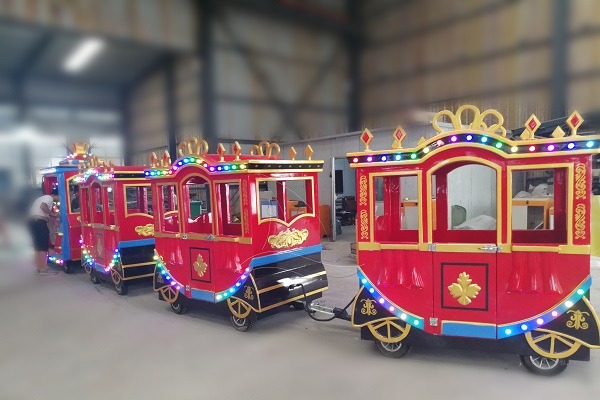
Floor Flatness and Evenness
Train carriages follow one another, so small irregularities are repeated along the whole consist. Measure flatness over the route: undulations cause rocking, uneven tyre wear, and passenger discomfort, while sudden steps damage suspension components. Where the floor is uneven, either repair it or adjust the route so the train avoids the worst sections.
Load-Bearing Capacity and Movement Joints
Confirm that the floor structure can carry the loaded train plus passengers, especially on suspended slabs, mezzanines, and upper-level routes. Expansion joints and thresholds should be checked for height differences: even a few millimetres can produce a repeated knock on every pass. Ramps and transition plates may be required to smooth the crossing.
Surface Type, Friction, and Cleanliness
Tyres grip differently on polished stone, ceramic tiles, vinyl, and concrete. On smooth indoor surfaces, the risk is slipping during acceleration or braking, particularly when floors are damp after cleaning. Discuss tyre compound and braking settings with the manufacturer, schedule train operation away from cleaning times, and mark wet-floor zones clearly. A properly configured trackless train indoor operation plan includes cleaning coordination with the mall’s facilities team.
Slopes and Gradient Limits
Indoor malls sometimes include gentle ramps between levels or sloped walkways. Each model has a maximum gradient when fully loaded, and exceeding it increases motor load, battery consumption, and brake wear. Measure the steepest section of the route, compare it with the manufacturer’s specification, and if necessary shorten the route or use a detour that keeps gradients within limits. The same principle applies to cross-falls, which can make a train drift sideways on long runs.
Turning Space and Obstacles
Check every corner against the train’s minimum turning radius, including the swept path of the last carriage. Columns, planters, promotional stands, and seating can all reduce the available space during busy trading hours. Mark the route on the floor plan and review it with mall management so that temporary displays do not block the service. Where the mall uses several routes, a purpose-built trackless mall train ride with a tighter turning radius keeps the service flexible.
Charging Area and Drainage
Indoor operations need a designated charging or battery-swap area with adequate ventilation, fire protection, and a level floor. Where the route passes near entrances, water from wet weather can reach the track; provide mats or drainage so tyres do not carry water into the mall or lose grip on smooth floors.
Floor flatness, load capacity, surface friction, gradient limits, and turning space are the five conditions that determine whether an indoor train service runs reliably. Work with an experienced Dinis indoor train supplier that can review your floor plan, and study the general principles of amusement ride floor loading when assessing structural capacity. To discuss models, gradients, and route options, visit https://www.dinistrains.com/trackless-mall-train-for-sale/ and share your mall layout.
Leave a Reply